

Aerospace Thermoplastics Market Outlook: Key Materials, Applications, and Opportunities

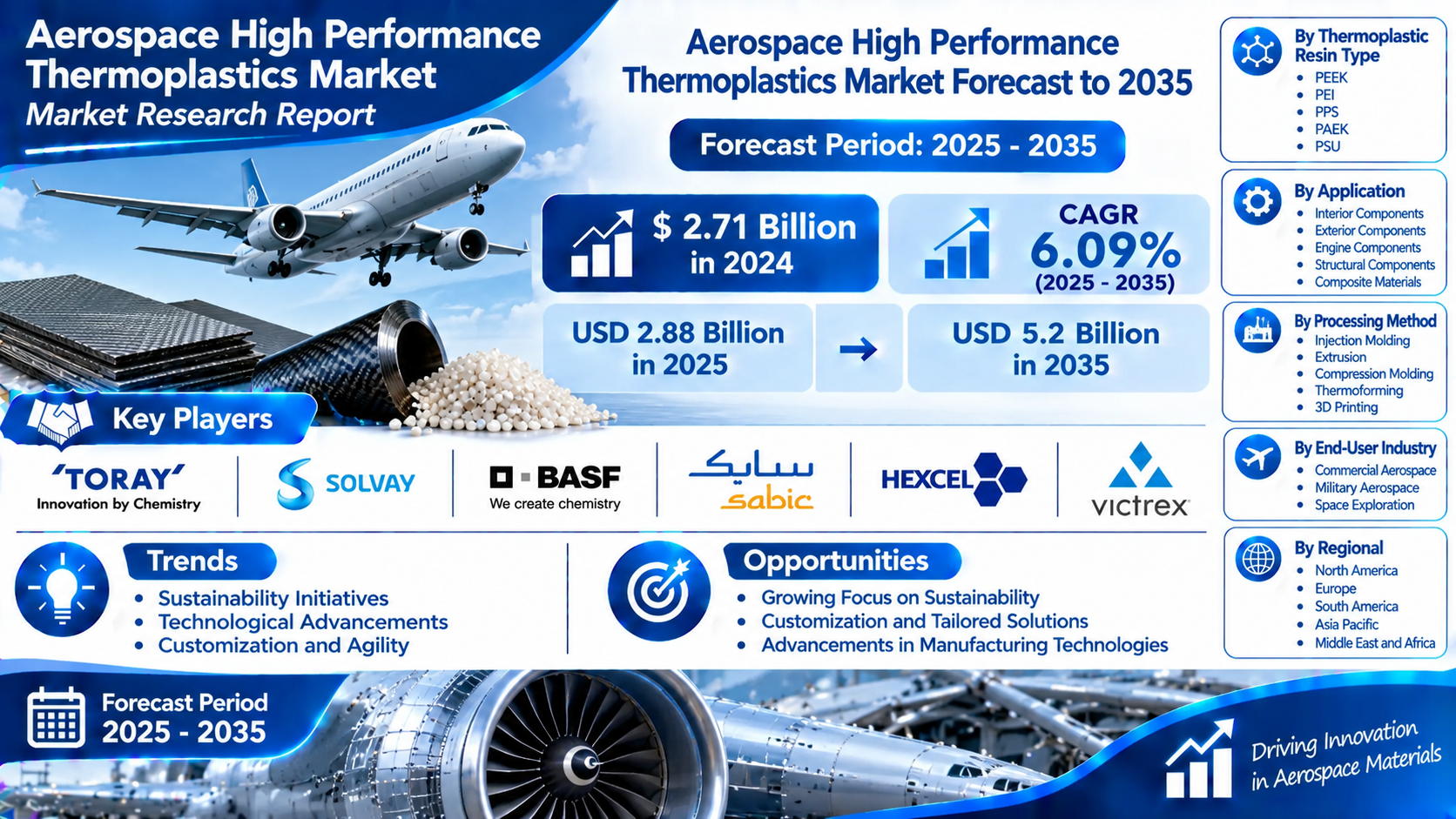
According to Market Research Future® (MRFR), the Aerospace High Performance Thermoplastics Market is projected to grow from USD 2.88 billion in 2025 to USD 5.2 billion by 2035, registering a compound annual growth rate (CAGR) of 6.09% during the forecast period from 2025 to 2035. The market was valued at USD 2.71 billion in 2024. Its development is supported by demand across commercial aerospace, military aerospace, and space exploration, alongside the use of advanced thermoplastic resins in interior, exterior, engine, and structural components. Sustainability initiatives, technological advancements, and customization are among the trends shaping the industry's direction.
Market Overview and Growth Outlook
High-performance thermoplastics are an important material category within the aerospace industry, where material selection is connected to component requirements and manufacturing processes. The market encompasses several resin types and applications, reflecting the range of aerospace components and materials covered by the industry. Its scope includes PEEK, PEI, PPS, PAEK, and PSU, alongside applications such as interior components, exterior components, engine components, structural components, and composite materials.
The market's projected expansion reflects the anticipated development of demand across its end-user industries. From USD 2.71 billion in 2024, the market is expected to reach USD 2.88 billion in 2025. The forecast value of USD 5.2 billion by 2035 represents continued growth over the ten-year period, with the stated CAGR of 6.09%. This outlook places emphasis on material innovation, manufacturing capabilities, and the ability of suppliers to meet specialized aerospace requirements.
Thermoplastic Resin Types
The market is segmented by thermoplastic resin type into PEEK, PEI, PPS, PAEK, and PSU. These materials form the product foundation of the market and are used within a range of aerospace applications. The presence of multiple resin categories allows the industry to serve different component and manufacturing requirements.
PEEK and PEI are among the listed resin types, while PPS, PAEK, and PSU broaden the market's material portfolio. The segmentation provides a framework for understanding the different materials available to aerospace manufacturers and the suppliers serving them. Product selection is influenced by the requirements of the intended component and the manufacturing process used to produce it.
For market participants, maintaining a portfolio across these resin types can support engagement with different customer applications. As aerospace manufacturers pursue material and production improvements, suppliers are expected to remain attentive to evolving specifications and the demand for tailored solutions.
Applications Across Aerospace Components
The application segmentation includes interior components, exterior components, engine components, structural components, and composite materials. Each category represents a distinct area of aerospace material use and contributes to the market's overall demand profile.
Interior components form one part of the application landscape, while exterior components represent another. Engine components and structural components extend the market into additional areas of aircraft and aerospace systems. Composite materials complete the listed application categories, connecting high-performance thermoplastics with material solutions used in composite applications.
The diversity of these applications is important to the market's development. Aerospace manufacturers require materials suited to different component functions, making product selection and processing capabilities relevant to suppliers. The range of applications also provides opportunities for companies to develop and supply solutions for specialized requirements.
Processing Methods and Manufacturing Capabilities
Processing method is another important dimension of the market. The report identifies injection molding, extrusion, compression molding, thermoforming, and 3D printing as the principal processing categories.
Injection molding and extrusion represent two of the listed methods, while compression molding and thermoforming provide additional manufacturing routes. 3D printing adds another category to the processing landscape. The presence of these methods reflects the variety of production approaches available for shaping and manufacturing high-performance thermoplastic components.
Manufacturing technology is also identified as an area of opportunity for the market. Advancements in manufacturing technologies can support the development of production capabilities and help suppliers respond to changing customer requirements. As aerospace applications become more specialized, processing methods and the ability to tailor manufacturing solutions remain important considerations.
End-User Industry Demand
The market serves three end-user industries: commercial aerospace, military aerospace, and space exploration. These segments represent different areas of aerospace activity and contribute to the industry's demand base.
Commercial aerospace is a major part of the market's end-user classification. Military aerospace represents a separate area with its own component and material requirements. Space exploration completes the segmentation, extending the market's scope beyond conventional commercial and military aircraft applications.
The presence of these three categories demonstrates the breadth of the market. Suppliers must understand the needs of different aerospace customers and align their material offerings with the requirements of each end-user industry. This creates a commercial environment in which product development, customization, and manufacturing capabilities are important.
Key Trends Shaping the Market
Sustainability initiatives are a major trend influencing the aerospace high-performance thermoplastics industry. The growing focus on sustainability is also identified as an opportunity, indicating that environmental considerations are relevant to both current industry direction and future market development.
Technological advancements form another important trend. Improvements in material development and manufacturing technologies can help companies respond to the evolving needs of aerospace customers. Technology is also included among the market's opportunities, reinforcing its role in supporting innovation and production capabilities.
Customization and agility complete the list of key trends. Aerospace applications involve different component types and end-user requirements, creating demand for solutions that can be adapted to specific needs. The ability to respond efficiently to changing specifications can therefore contribute to a supplier's competitiveness.
Opportunities and Competitive Landscape
The market's identified opportunities include a growing focus on sustainability, customization and tailored solutions, and advancements in manufacturing technologies. These areas provide potential avenues for companies to strengthen their offerings and address changing aerospace requirements.
Customization is particularly relevant to a market serving interior, exterior, engine, and structural components, as well as composite materials. Tailored solutions can help suppliers address the different requirements associated with these applications. Manufacturing advancements may further support product development and production improvements.
The key players identified in the market are Toray Industries, Solvay, BASF, SABIC, Hexcel Corporation, and Victrex. These companies participate in the competitive landscape for aerospace high-performance thermoplastics. Competition is shaped by material portfolios, manufacturing capabilities, technological development, and the ability to serve specialized aerospace applications.
Regional Market Outlook
The regional segmentation includes North America, Europe, South America, Asia Pacific, and the Middle East and Africa. These regions represent the geographic scope of the market assessment. Regional demand is connected to aerospace activity and the presence of commercial, military, and space-related applications.
Future Outlook
The aerospace high-performance thermoplastics market is projected to reach USD 5.2 billion by 2035, supported by a CAGR of 6.09% from 2025 to 2035. Its growth outlook reflects demand across multiple aerospace end-user industries and applications, supported by a portfolio of thermoplastic resin types and processing methods.
Sustainability initiatives, technological advancements, and customization are expected to remain important considerations for market participants. Opportunities related to tailored solutions and manufacturing innovation may further influence the industry's development. The combination of diverse applications and specialized end-user requirements gives the market a broad foundation for its anticipated expansion through 2035.


